- Our California office it's now
- 13:56 PM(Fri) - We Are Open
- Tel: 1-909-988-8885 Toll free : 1-855-325-2726 (USA & CANADA)
- Whatsapp: Website Line : 1-909-914-8063
- info@alljapantours.comFollow Us :


- Monday to Friday 8:30AM - 5:30PM (PST) Saturday 9:00AM - 3:00PM (PST)
- CONTACT US
UNESCO World Heritage Sites
Temples
Shrines
Castles
Gardens
Historic Towns and Districts
Sacred and Pilgrimage Sites
Pottery Towns
Museums
Festivals
Manga and Anime
Onsen
Nature
Natural Sceneries
Wildlife
Cherry blossoms
Autumn Leaves
Flowers
Theme Parks
Geisha
Sumo
Ninja
Samurai
Traditional Sports
Traditional Performing Arts
Traditional Culture Experiences
Food
Drinks
Originating in the 14th century, Noh is a traditional form of theatre involving music, dance, and drama.
During the Muromachi Period (1333-1573), a man named Zeami popularized and formalized the Noh we know
of today. Four main noh troupes were established during this era, receiving sponsorship from shrines and
temples.
It was during the Tokugawa Period (1603-1867) that Noh became even more standardized when the
shogunate made it the official ceremonial art and issued regulations for its governance. Furthermore,
tradition was emphasized instead of innovation. A fifth troupe was also added during this time. This would
make five main noh troupes that are still performed till this day.
Structured around music and dance, Noh theater consists of slow movement, poetic language, monotonous
tone, and brilliant costumes. Plots are usually based on history, legend, literature and contemporary events.
Themes in Noh plays are often related to dreams, ghosts, spirits and supernatural worlds.
All performers in Noh plays are male. There are five essential roles that are involved to create an outstanding
performance.
There is a leading character called Shite. The shite may act as a deity, a holy man, a demon, a spirit, or a living
man depending on each play. Movements are used to express various moods.
The supporting character, waki, plays roles such as a monk, priest or samurai. The waki always portrays living
people in contrast to the shite.
The musicians are known as Hayashi. There are four musicians that provide soundtrack for the performance
using a flute (fue), shoulder drum (kotsuzumi), hip drum (otsuzumi) and stick drum (taiko).
The chorus, Jiutai, sits to the left of the stage and collaborates with the shite in the narration of the story.
Lastly, there are stage attendants called Koken. They dress in black and assist the performers in various ways,
such as handing them props, but are not directly connected to the story.
There are a variety of types of Noh plays. For instance, the kami (god) play involves a sacred story of a Shintō
shrine, shura mono (fighting play) centers on warriors, katsura mono (wig play) has a female protagonist, and
gendai mono (present day play) is a story considered contemporary and realistic rather than legendary and
supernatural.
Masks in which the shite wears are equally important in noh plays. It lets the audience know what kind of
character is being portrayed. Masks representing demons, spirits, as well as women and men of various ages
are frequently used. They are carved from blocks of Japanese cypress. The three dimensional properties allow
skilled actors to create various expressions using changes in head orientation.
Costumes are composed of multiple layers, textures, and details to create a majestic grace, yet an effect of a
bulky, massive figure as well. Notably, expressiveness is achieved through props, such as a folding fan. The
fan may represent any prop suggested by its shape and handling.
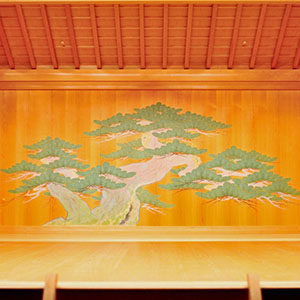
You can watch noh today in modern indoor theaters with an in-built noh stage. Well known venues are
located in Tokyo, Osaka, and Nagoya. The program usually lasts for a couple of hours, which consists of a few
Noh acts, along with short kyogen pieces in between.