- Our California office it's now
- 12:57 PM(Fri) - We Are Open
- Tel: 1-909-988-8885 Toll free : 1-855-325-2726 (USA & CANADA)
- Whatsapp: Website Line : 1-909-914-8063
- info@alljapantours.comFollow Us :


- Monday to Friday 8:30AM - 5:30PM (PST) Saturday 9:00AM - 3:00PM (PST)
- CONTACT US
UNESCO World Heritage Sites
Temples
Shrines
Castles
Gardens
Historic Towns and Districts
Sacred and Pilgrimage Sites
Pottery Towns
Museums
Festivals
Manga and Anime
Onsen
Nature
Natural Sceneries
Wildlife
Cherry blossoms
Autumn Leaves
Flowers
Theme Parks
Geisha
Sumo
Ninja
Samurai
Traditional Sports
Traditional Performing Arts
Traditional Culture Experiences
Food
Drinks
Geisha
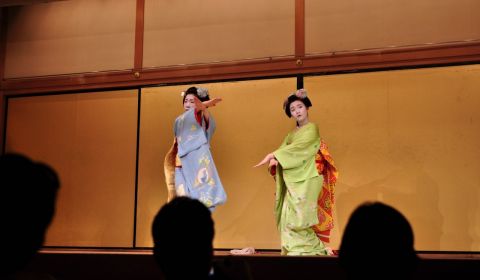
Geisha are traditional Japanese female entertainers who act as hostesses, mainly to entertain
male customers. Their skills include performing a variety of Japanese arts such as classical
music, dance, games, and conversation.
Like all Japanese nouns, geisha has no distinct singular or plural variants. In English, the most
literal translation of geisha would be "artist," "performing artist," or "artisan." Geiko is another
name for geisha, which is usually used to refer to geisha from western Japan, including Kyoto.
Maiko is an apprentice geisha, translating to “dance child”. They are also referred as hangyoku,
or "half-jewel", meaning that they are paid half of the wage of a full geisha. A more generic term
is o-shaku, "one who pours (alcohol)".
The white make-up, maiko hair, and elaborate kimono is the popular image held of geisha. A
woman does not have to begin as a maiko when entering the geisha community, having the
chance to begin her career as a full geisha. Nonetheless, a year's training is usually involved
before debuting either as a maiko or geisha.
A woman above 21 is no longer considered to be a maiko, and upon her initiation into the
geisha community, she becomes a full geisha.
Only in Kyoto can a modern maiko apprentice before the age of 18. On average, Tokyo maiko
typically begin at age 18. They are slightly older than their Kyoto counterparts, who usually start
at 15. The stages of geisha training takes years.
Today, it is still said that geisha live in a separate reality, an elegant and high-culture world. They
call it the karyūkai, or "the flower and willow world." Before their dissipation, the courtesans
were the colorful "flowers" and the geisha "willows" because of their strength, grace, and
subtlety.
Modern geisha still live in traditional geisha houses (okiya), which are in areas called hanamachi
("flower towns"), usually during their apprenticeship. Many experienced geisha are successful
enough to have the option of choosing to live independently.
Before the 20th century, geisha training began around age four. Now, girls usually go to school
until their teens and then make the personal decision of training to become a geisha. Young
women who aspire to be a geisha often begin their training after completing middle school,
high school, or college. Adulthood is when many women begin their careers.
Geisha still study traditional instruments, including the shamisen, shakuhachi, and drums. They
acquire skill in games, traditional songs, calligraphy, Japanese traditional dances (in the
nihonbuyō style), tea ceremony, literature, and poetry.
Women dancers draw their art from butō (a classical Japanese dance) and are trained by the
Hanayagi school, whose top dancers perform internationally. With the assistance of the owner
of the geisha and from watching other geisha, apprentices become proficient in dealing with
clients as well. They also grasp the complex traditions of selecting and wearing kimono, a floor
length silk robe embroidered with intricate designs held together by a sash (obi) at the waist.
Geisha tradition is considered to prevail in Kyoto, where it is the strongest today, including Gion
Kobu. The geisha in these districts are referred as geiko. The Tokyo hanamachi of Shimbashi,
Kagurazaka, and Asakusa are also well known districts.
In modern Japan, geisha and maiko are considered a rare sight outside of hanamachi. There
were over 80,000 geisha in Japan during the 1920s, but today, there are far fewer. The exact
number of geisha is unknown to outsiders. It is estimated to be from 1,000 to 2,000, mostly in
the resort town of Atami. The most common sightings are of tourists who pay a fee to be
dressed up as maiko.