- Our California office it's now
- 12:57 PM(Fri) - We Are Open
- Tel: 1-909-988-8885 Toll free : 1-855-325-2726 (USA & CANADA)
- Whatsapp: Website Line : 1-909-914-8063
- info@alljapantours.comFollow Us :


- Monday to Friday 8:30AM - 5:30PM (PST) Saturday 9:00AM - 3:00PM (PST)
- CONTACT US
UNESCO World Heritage Sites
Temples
Shrines
Castles
Gardens
Historic Towns and Districts
Sacred and Pilgrimage Sites
Pottery Towns
Museums
Festivals
Manga and Anime
Onsen
Nature
Natural Sceneries
Wildlife
Cherry blossoms
Autumn Leaves
Flowers
Theme Parks
Geisha
Sumo
Ninja
Samurai
Traditional Sports
Traditional Performing Arts
Traditional Culture Experiences
Food
Drinks
Food
Japanese cuisine is famous for its highly skilled preparation routine as well as its distinctive and cultivated
presentation. The Japanese do not exclusively depend on herbs and spices to season their food, unlike
other types of Asian dishes. Each ingredient is meticulously chosen and kept in unity with its own original
taste.
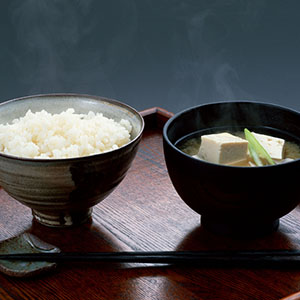
Traditionally, food in Japan is based on rice, miso soup, and other dishes with an emphasis on seasonal
ingredients. Fish, pickled vegetables, and vegetables cooked in broth are typical side dishes. Fish is
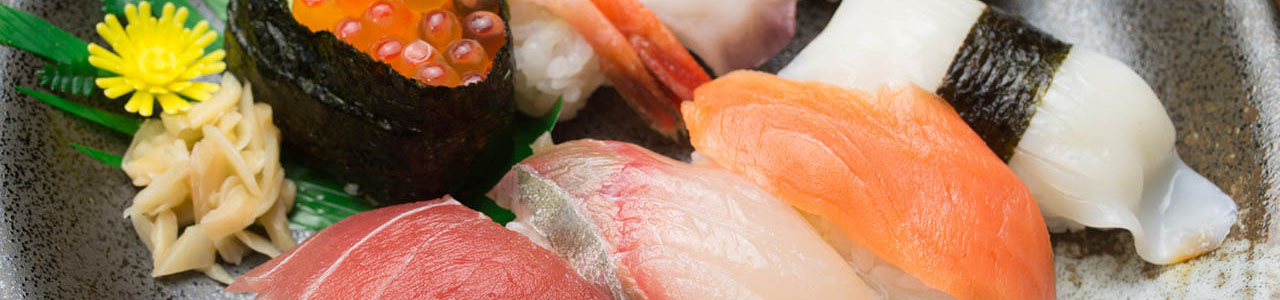
standard in the traditional cuisine. It is often grilled, or served raw as sashimi or in sushi. There is also
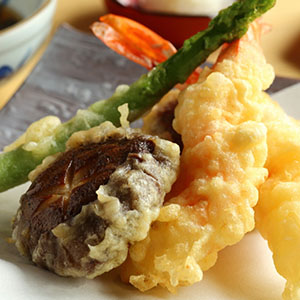
tempura, which is seafood and vegetables deep-fried in a light batter. Sushi has expanded throughout the
world, as it is distinctive for Japanese cuisine.
Apart from rice and noodles, such as soba and udon, Japan has an assortment of dishes. In particular, fish
products in broth called oden, or beef in sukiyaki and nikujaga. Foreign food, specifically Chinese, can be
found in the form of fried dumplings (gyoza) and noodles in soup (ramen). Western food including
hamburgers and curry are recurrent in Japan as well.
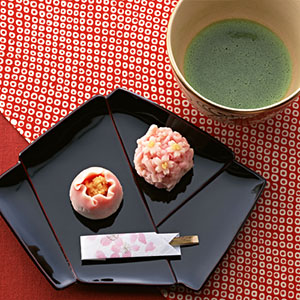
Japan has a native form of sweets called wagashi, which may include, notably, red bean paste as an
ingredient. There is also a variety of rice wine, known as sake.
Vegetable dishes are usually flavored with the ever-present dashi stock, often consisting katsuobushi
(dried skipjack tuna flakes). Provided that, strictly vegetarian food can be hard to come across. Although,
an exception to this would be a Buddhist cuisine called shōjin-ryōri. At the same time, the shōjin-ryōri
promoted at restaurants may include some non-vegetarian ingredients.
The accustomed Japanese diet contains high fiber content and low cholesterol and calories. Rice is
present in nearly every Japanese meal, and udon and soba noodles are standard as well. Soybean
products, beans, fish, seaweed, fruit, and vegetables is exceptionally prevalent in Japanese cuisine.
Teriyaki, tempura, and yakitori are also recurrent Japanese dishes.
Some standard Japanese foods include: pickled or salted vegetables (tsukemono), deep-fried dishes
(agemono), steamed foods (mushimono), grilled and pan-fried meals (yakimon), sliced raw fish (sashimi),
soups (shirumono and suimono), stir-fried meals (itamemono), vinegared dishes (sunomono), and
simmered dishes (nimono).
Today, Japan is prolific with local and moderately inspired Western-style food. Most of these foods were
invented during the emergence of the 1868 Meiji restoration. At the end of the country’s seclusion,
influence from the foreign (particularly Western) culture led to assorted restaurants serving Western food,
known as yōshoku. Western cuisine restaurants are called yōshokuya.
Numerous yōshoku items have been established to an extent where they are considered Japanese, and
are an inherent component of the Japanese menu. These foods are typically served together with rice and
miso soup, and are eaten with chopsticks. Although this may be true, these foods are still classified as
yōshoku due to their origins, in contrast with the more conventional washoku (Japanese cuisine).
Listed below are several common yoshoku:
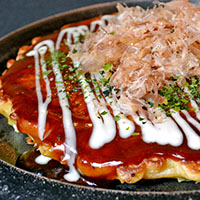
Okonomiyaki
a savoury pancake containing an array of ingredients
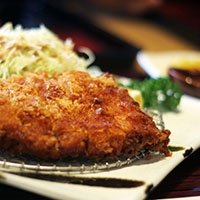
Tonkatsu
a breaded, deep-fried pork cutlet
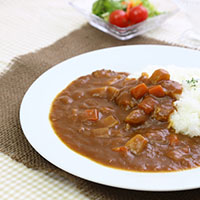
Curry
This was introduced by the British in the Meiji era. However, Japanese curry is unique compared to other forms. Japanese
variations include curry bread, curry udon, and "katsu-curry" (tonkatsu served with curry).
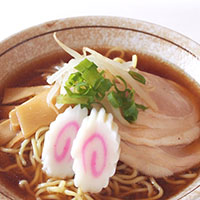
Ramen
This is a Chinese influenced food consisting of wheat noodles served in a meat stock broth. Ramen has become exceedingly
widespread over the last century.