- Our California office it's now
- 12:57 PM(Fri) - We Are Open
- Tel: 1-909-988-8885 Toll free : 1-855-325-2726 (USA & CANADA)
- Whatsapp: Website Line : 1-909-914-8063
- info@alljapantours.comFollow Us :


- Monday to Friday 8:30AM - 5:30PM (PST) Saturday 9:00AM - 3:00PM (PST)
- CONTACT US
UNESCO World Heritage Sites
Temples
Shrines
Castles
Gardens
Historic Towns and Districts
Sacred and Pilgrimage Sites
Pottery Towns
Museums
Festivals
Manga and Anime
Onsen
Nature
Natural Sceneries
Wildlife
Cherry blossoms
Autumn Leaves
Flowers
Theme Parks
Geisha
Sumo
Ninja
Samurai
Traditional Sports
Traditional Performing Arts
Traditional Culture Experiences
Food
Drinks
Temples
In Japan, Buddhist temples are places for paying reverence to objects of spiritual worship as well as other
religious activities and observances.
Buddhist temple composites originated in India, where the main structures were quarters known as vihara,
where monks engaged in religious training. There were also chaitya halls for worshiping Buddhist images,
and rounded stupas said to enshrine bits of bone (sarira, or shari in Japanese) from the historical Buddha,
Siddhartha Gautama. Buddhist temples in Japan developed a unique individuality after incorporating
influences from China and Korea.
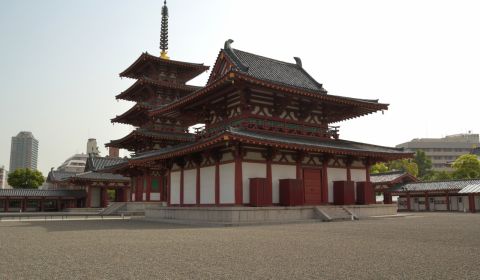
During the Asuka and Nara periods, many temples had a design following the Shitennoji model, centering
around a tower-like pagoda. This was for the worship of shari relics and was considered more essential than
the kondo, the worship of Buddhist images.
Pagodas and image halls were given equal prominence in the later transitioned layout of the Horyuji model.
The halls that housed Buddhist images gradually took a central position and pagodas were given the
"decorative structures” role, like in the Yakushiji and Todaiji Temples in Nara.
The forms of temple compounds became more diverse with the spread of “esoteric Buddhism” (mikkyo) in
the Heian period as well as the spread of the raigo concept. The appearance of Amida Halls with attached
gardens in a single compound, inspired by the desire to produce replicas of Amida's "Western Paradise of the
Pure Land", had surfaced.
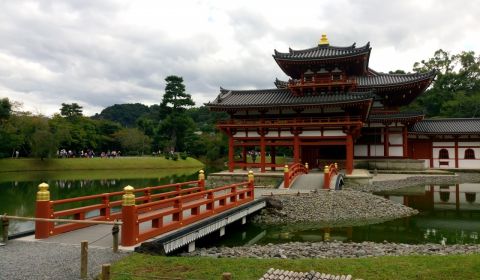
The Phoenix Hall (Hoodo) of the Byodoin south of Kyoto is the most famous structure of this type. New
temple styles were adopted from the Asian continent due to the popularity of Zen in the Muromachi period.
Numerous imposing Zen compounds were also constructed at this time.
While large cultural centers like Kyoto have several thousands of temples, virtually every Japanese
municipality has at least one temple. Buddhist objects are stored and displayed at temples. Some temples
were formerly monasteries, and some still function as such. Structures typically found at Japanese temples
are:

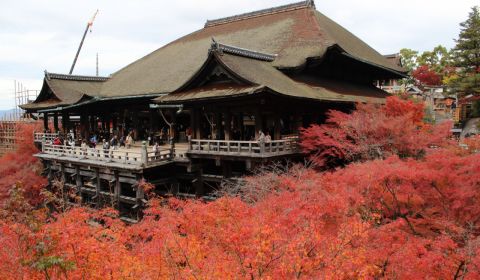
Main hall
Main halls display sacred objects of worship, such as statues. In Japanese, main halls are known as kondo, hondo, butsuden, amidado, or hatto.
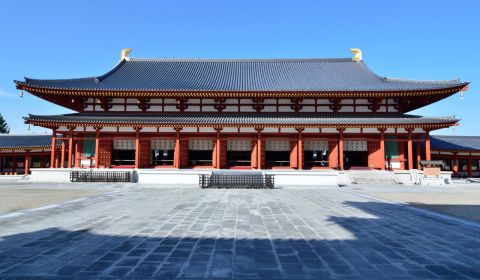
An example would be the main hall of Todaiji in Nara.
Lecture hall
Lecture halls are for meetings and lectures. They often display objects of worship as well. Lecture halls are called kodo in Japanese.
To illustrate, visit the lecture hall of Toji in Kyoto.
Pagoda
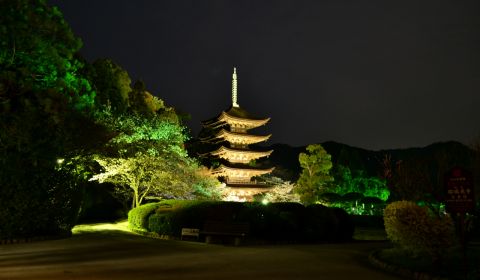
A pagoda is a structure that has evolved from the Indian stupa. It usually comes with three (sanju no to) or five (goju no to) stories. Remains of the
Buddha, such as a tooth, are usually stored in pagodas.
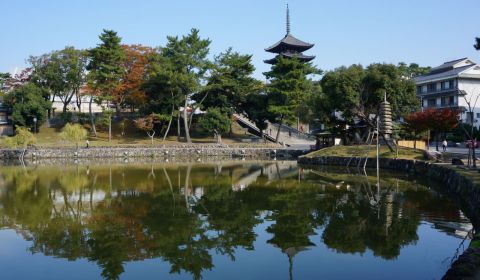
For instance, you can see the 3-storied pagoda of Kofukuji in Nara.
Gates
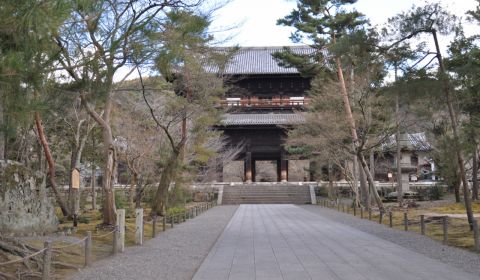
Gates mark the entrance of temple grounds. Generally, there is one main gate and possibly several additional gates along the temple's main entryway.
To point out, the Sanmon Gate of Kenchoji is in Kamakura.
Bell
Temple bells are rung 108 times on New Year’s Eve, corresponding to the Buddhist concept of 108 worldly desires.
The Great Bell of Kenchoji is in Kamakura for reference.
Cemetery
In Japan, most cemeteries are Buddhist and are located at a temple. The Japanese visit their ancestors' graves on many occasions during the year,
especially during the obon week.
The best cities to visit temples are in Kyoto, Nara, and Kamakura. If you are interested in an overnight stay at a temple, Mount Koya is one of the best
places to experience this.
Difference between Temples & Shrines
Temple and shrine are both used interchangeably because many
visitors to Japan can’t tell the difference. To point out, using these terms
interchangeably is like saying a church and synagogue are equivalent. In
Japan, there are two major religions practiced by the Japanese people. A
shrine is where Shinto is practiced and Buddhism is practiced at a
temple.
Both Shinto and Buddhism date back to thousands of years. Shinto, a
spiritual principle, is an ancient religion of Japan based on the belief that
powerful deities called kami (gods) inhabit both heaven and earth.
According to mythology, various kanami were worshipped by their own
individual clans. They often built shrines dedicated to their chosen kami
and utilized a shaman or diviner to help them pray.

In Japanese, Shinto is referred as kami no michi (the way of the gods), but its Chinese ideogram and pronunciation for the
words are ”shin tao” or Shinto.
In the sixth century, China and Korea introduced Buddhism to Japan. It gained wide acceptance in the following century
when the nobility advocated it. Bukkyō, a combination of two words, is the Japanese word for Buddhism. Butsu translates to
Buddha and kyō means doctrine.
In Japan, most people practice both faiths ambiguously as they are nearly parallel to one another. Shinto primarily focuses
on earthly matters, and shrines are often used to host weddings or pray for good fortune. Whereas Buddhism is considered
the religion of spiritual beliefs and practices. Temples usually host funerals and are a place to pray for ancestors.
You are probably at a Shinto shrine if you cross the threshold of a torii gate, see a pair of guardians (usually dogs or lions)
sitting on each side of the entrance, and cleanse your mouth and hands at a purification fountain before prayer. Shinto
shrines have the suffix “jingu”, such as Ise Jingu.
The name of Buddhist temples use the suffix ”ji”, such as Todaiji. You may find yourself at a Japanese temple if you see an
image of the Buddha, as this is always housed at a Buddhist temple. A large incense burner is usually located at the front of
the temple; it is believed that the smoke has healing properties. On top of that, there is often a pagoda at a Buddhist
temple.
A visit to Japan is not complete without appreciating and taking in the experience of being in a temple and shrine. Large and
iconic, or small and local, they are all unique and it is worth taking the time to visit.